Buying Guide · 2026

Best Motorcycle Helmets 2026: The Complete Buyer's Guide

The helmet market is massive, noisy, and full of gear that looks the part but doesn't earn it. Big-box retailers shelf 300 options by price point and hope you pick one. We don't do that. This guide covers the helmets we actually carry — full-face sport lids, modular tourers, and women's-specific fits — with straight talk on what the safety ratings mean, how to measure for fit, and which helmets are worth your money in 2026.

Updated May 2026 · 5 helmets reviewed · 4 categories covered

Motorcycle Helmet Safety Ratings Explained

Every helmet sold in the US carries a DOT sticker. Most quality lids also carry ECE certification. A few carry Snell. These aren't marketing badges — they're independent impact tests with different protocols, thresholds, and philosophies. Understanding what each certification actually tests tells you which helmet to buy for how you ride. The short version: ECE 22.06 is the current global benchmark. DOT is the US legal minimum. Snell M2020 is the strictest rotational impact standard. If a helmet only has DOT, keep looking.

Certification Standards at a Glance

DOT (FMVSS 218) US legal minimum. Self-certified by manufacturers. Lowest threshold of the three — necessary but not sufficient.
ECE 22.06 (2022) European standard, third-party tested. Updated 2022 to include rotational impact (MIPS-class) testing. Current global benchmark — look for "22.06" not older "22.05."
Snell M2020 Strictest independent standard. Third-party tested. Historically favored by track riders — higher energy impacts, penetration resistance, roll bar tests.
SHARP (UK) UK government's 1–5 star rating based on independent test data. A useful secondary check — a 5-star SHARP rating means the lid performed well across multiple impact scenarios.

Best Full-Face Helmets

Full-face helmets are the gold standard of motorcycle protection — chin bar covers the most common point of first impact in a crash. For sport, commuting, and track riding, there's no argument. The tradeoff vs. modular is weight and ventilation rigidity: a full-face is lighter (no hinge mechanism) and structurally continuous (no joint in the chin bar). If you're choosing between a full-face and a modular at the same price point, the full-face will be lighter, quieter, and have a stronger chin bar. The modular only wins when you're regularly stopping for conversations, stopping for fuel with a hydration pack, or touring in conditions where you want the option to flip up without removing the helmet.

Shoei RF-1400 Helmet
Full-Face

Shoei RF-1400

Shoei's sharpest sport full-face. CNS-1C fiberglass shell is lighter and stronger than the RF-1200 it replaced. NeoTec Max-Dry liner. CWR-F2 anti-fog shield — no Pinlock required. Emergency Quick Release. DOT + ECE certified. The helmet you stop thinking about once you put it on.

Bell Race Star Flex DLX Helmet
Carbon Shell

Bell Race Star Flex DLX

3K carbon fiber shell. Bell's Flex Safety System uses three-layer liner technology to handle low, mid, and high-energy impacts each differently — instead of one foam compromising on all three. Panovision photochromic shield auto-darkens in sunlight. Snell M2015 + DOT. The track-day lid.

Best Modular Helmets

Modular helmets get dismissed by sport riders as compromise pieces — and for track use, that's fair. The chin bar hinge is a structural weakness, they're heavier, and the joint introduces wind noise. But for touring and commuting, the modular is the correct tool. Being able to flip up at a toll booth, talk to a gas station attendant, or eat lunch without removing the helmet entirely changes how you interact with the world on longer trips. The secret to a good modular helmet is a chin bar that seals completely when locked — a gap at the bottom is how you get wind noise at 70mph. Cheap modulars fail this test. Quality ones (Shoei, Schuberth, Nolan) don't.

Shoei Neotec 3 Modular Helmet
Modular

Shoei Neotec 3

Shoei's flagship modular. CNX-1 multi-ply composite shell is as quiet and rigid as any Shoei full-face — the chin bar mechanism adds weight but not wind noise because it seals completely. Integrated drop-down sun shield. Wide-open aperture with no tunnel vision. Emergency Quick Release chin bar. Bluetooth-ready speaker pockets. The one helmet for every condition.

Best Women's Fit Helmets

The fit issue in motorcycle helmets is documented and real: most "XS" helmets in unisex lines are tooled on a male head form — rounder crown, wider temporal area, looser at the cheekbones. Women typically have a narrower oval head shape with a more prominent occipital bone. A correctly sized unisex XS can sit high and rotate; an aggressively sized one pinches at the sides without actually fitting. Look for helmets explicitly built on a narrow-oval last, or women's-specific shell sizes — not just "available in XS." The good news: safety ratings don't change based on who the helmet fits. ECE 22.06 and DOT on a properly fitted women's helmet means the same protection as any other certified lid. The women's-specific options we carry close the fit gap without compromising the protection.

Shoei RF-1400 Women's Fit Helmet
Women's Fit

Shoei RF-1400 — Women's Fit

XS–M shell sizes built on a narrow-oval interior liner. Same CNS-1C fiberglass shell, NeoTec Max-Dry liner, and Emergency Quick Release as the full RF-1400 line — right fit without compromising construction or certifications. For women who want full-face sport protection without the unisex fit problem.

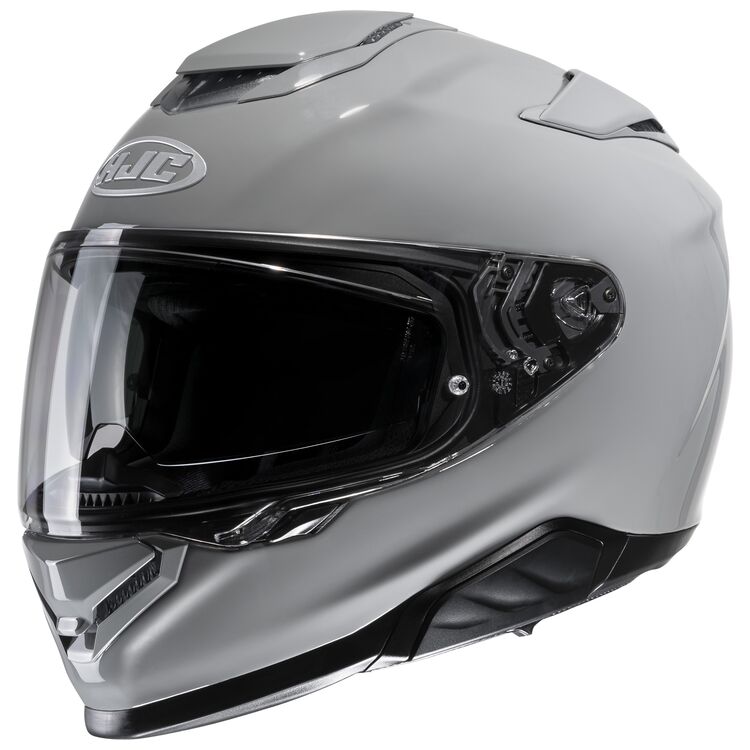
HJC RPHA 11 Pro Women's Helmet
Best Value

HJC RPHA 11 Pro — Women's

XS shell tooled on a narrower last than the men's line. Premium integrated matrix composite. Integrated drop-down sun shield. Pinlock 70 EVO included — anti-fog out of the box. Bluetooth speaker pocket. Full CE and DOT certified. The entry point to women's-specific fit at a price that doesn't require a second mortgage.

How to Measure for a Motorcycle Helmet

Fit is the single most important factor in helmet safety. A helmet that moves on your head in a crash is one that isn't protecting you. These benchmarks apply across every brand we carry.

How to Measure

Wrap a soft tape measure around your head at the widest point — just above the ears, across the mid-forehead, around the occipital bump at the back. Measure twice. The larger of the two numbers is your head circumference. Use centimeters for accuracy — millimeters matter in helmet sizing.

Size Chart (cm)

XS = 53–54cm · S = 55–56cm · M = 57–58cm · L = 59–60cm · XL = 61–62cm · XXL = 63–64cm. When you're between two sizes, try both — head shapes vary, and size charts are a starting point, not a verdict.

Head Shape

Round oval: widest dimension is roughly equal front-to-back and side-to-side. Intermediate oval: slightly longer front-to-back. Long oval: noticeably longer front-to-back, narrower side-to-side. Most helmets are built on intermediate oval. If you're round or long oval, look for brand-specific shape notes — Shoei tends to suit intermediate-to-long oval, HJC suits intermediate-to-round.

The Fit Test

Put the helmet on and fasten the chin strap. Grip the back of the helmet and try to roll it forward off your head. If it moves more than an inch before the chin strap catches, it's too large. Try to push the sides in — there should be even pressure across both cheeks. No pressure points in the first 15 minutes means the fit is likely correct for your head shape.

Shop All Helmets

5 curated lids. Every one certified, sized right, and worth what you pay for it.

Shop All Helmets →